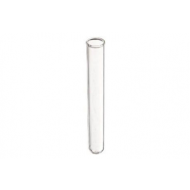
Glass Test Tubes (pack of 10)
R 19,78 – R 89,99
Price in ZAR, VAT inclusive. Bulk pricing on request.
Available pack sizes
- Nationwide delivery and export packing
- SDS and CoA available on request
- Supplied for laboratory and industrial use
Product description
Glass Test tubes plain glass round bottom is made of borosilicate glass to reduce pH change and contaminants potentially leached from soda-lime glass. Test Tubes are well annealed, resistant to heat, and chemically stable. Glass test tubes with beaded rims are fire-polished.
A chemistry test tube typically has a flat bottom, a round bottom, or a conical bottom. Some test tubes are made to accept a ground glass stopper or a screw cap. They are often provided with a small ground glass or white glaze area near the top for labelling with a pencil.
Test tubes are widely used by chemists to handle chemicals, especially for qualitative experiments and assays. Their spherical bottom and vertical sides reduce mass loss when pouring, make them easier to wash out, and allow convenient monitoring of the contents. The long, narrow neck of test tube slows down the spreading of gases to the environment.
Test tubes are slender containers that hold small amounts of liquid and are used in scientific experiments. They can range between 50 mm to 250 mm in length and 13 and 20 mm in width. Test tubes are usually made of glass or plastic. They can be used for chemical reactions, heating solutions, and even growing organisms.
Test tubes intended for general chemical work are usually made of glass, for its relative resistance to heat. Tubes made from expansion-resistant glasses, mostly borosilicate glass or fused quartz, can withstand high temperatures up to several hundred degrees Celsius.
Test tubes are used to hold, mix, and heat chemical experiments. They are used as homes for microorganisms when people want to culture (grow) them. They are also used as collections devices for things like blood samples.
Boiling Tube
A boiling tube is a small cylindrical vessel used to strongly heat substances in the flame of a Bunsen burner. A boiling tube is essentially a scaled-up test tube, being about 50% larger.
They are designed to be wide enough to allow substances to boil violently as opposed to a test tube, which is too narrow; a boiling liquid can explode out of the end of test tubes when they are heated, as there is no room for bubbles of gas to escape independently of the surrounding liquid. This phenomenon is called bumping.
Being large and thick-walled, it is primarily used to hold small quantities of substances which are undergoing direct heating by a Bunsen burner or other heat source. This type of tube is used in the sodium fusion test.
Ignition tubes are often difficult to clean due to the small bore. When used to heat substances strongly, some char may stick to the walls as well. They are usually disposable.
Need bulk or export quantities?
We supply Glass Test Tubes (pack of 10) in drum, IBC and container quantities with documentation for cross-border shipments.
- Volume pricing tiers
- CoA, SDS & export docs
- Scheduled call-off supply
Glass Test Tubes (pack of 10) — frequently asked questions
Pricing, pack sizes, documentation and delivery answers for buyers sourcing this product.
Related products
Glass Filter Funnels
R 37,71 – R 236,39
Incl. VAT · In stock
Watch Glasses
R 23,55 – R 71,34
Incl. VAT · In stock
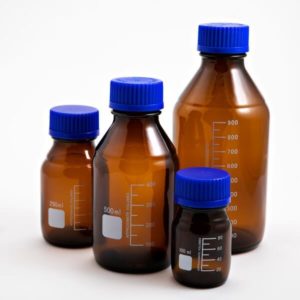
Amber Schott Bottles Blue Screw GL45 Cap
R 139,30 – R 439,72
Incl. VAT · In stock
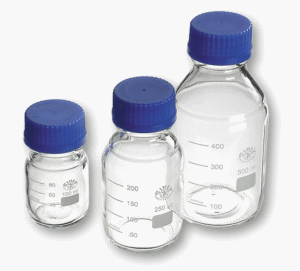
Schott Bottle Blue GL45 Cap
R 70,91 – R 5 011,38
Incl. VAT · In stock